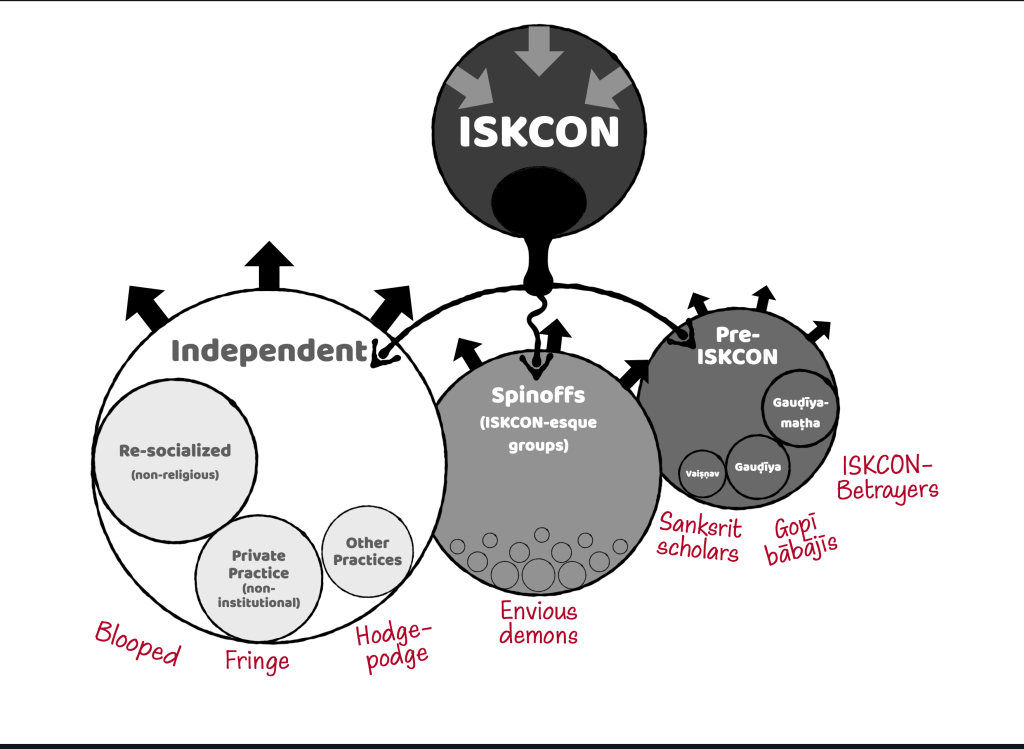
ISKCON shrinks, losing members like blood flowing out of a wound. The size of the wound increased dramatically with the loss of it’s original charismatic leader.
The largest flow pools in an “independent group”. The main subgroup here consists of people who go back to living a relatively normal mainstream lifestyle, giving up on their hopes of a spiritual alternative. A smaller subgroup are those who lose hope in any communal or institutional participation, and practice bhakti independently. A third subgroup (perhaps larger than the second?) are those who become eclectic or convert to other religions or other aspects of Hinduism or spirituality.
The second largest flow consists of people who band together to form new organizations that oppose some specific details or aspects that drove them out of ISKCON. Some of these groups try to ignore ISKCON and do their own thing. Others try to reform ISKCON and hope for re-integration.
The smallest flow seeks refuge in pre-ISKCON sources of bhakti. The main portion of these takes shelter of the various fragments of ISKCON’s predecessor institution, the Gauḍīya maṭha. Another, smaller group takes shelter of Gauḍīya lines not directly linked to ISKCON’s immediate predecessor. A third, still smaller group, moves towards bhakti not directly linked to ISKCON’s broader school under Śrī Caitanya.
Derogatory Terms
The bottom of the diagram shows common derogatory terms ISKCON members use to refer to each group.
“Blooped” can also refer to any who exit ISKCON. It is a gradient, more commonly applied to the groups towards the left of the diagram becoming palpably common in reference to the first pool, the independent group. The other groups are less “blooped” and more “envious.” This term, envious, can be seen as a spectrum that moves in reverse of the “blooped” epithet. This seems to reflect that ISKCON does not tend to see the independent group as a direct threat or competition.
Generally, the spinoffs are seen as being envious of and insulting towards ISKCON’s current leaders, while the pre-ISKCON group is seen as being envious of or insulting towards ISKCON’s founder, especially those who moved outside the Gauḍīya Maṭha.
The more “progressive” leaders of ISKCON may exhibit some sympathy or unity with some members of the Gauḍīya-maṭh or Spinoff groups. Usually this depends on those groups voicing praise of ISKCON and never any significant criticism. However, this sympathy is usually penalized harshly by ISKCON’s Governing Bodies and is soon censored in the organization. There is almost never any solidarity or respect from ISKCON towards any other group.
“Karmī” is another option to deride the re-socialized. The implied insult is, “you are going to hell.”
The more complete version of the “Gopī” epithet is “Gopī-bhāva club.” The implied insult is “transvestite poseur.” Actually, the far more common slur is, “sahajīya” – “wild, sex-crazed poseur.”
Certain terms are used with conscious or subconscious sarcasm, for example, “Sanskrit Scholars.” The implied insult is, “know-it-all pencil-neck geek.”

 Vic DiCara's Astrology - Radically Classical, Radically Deep
Leave a reply to mantrashaman Cancel reply