Rotation and Revolution of Bhū
Śuka said the circumference at the utmost peak of Meru is 10,000 ky, a simple 100 x 100, where 100 = the circumference of Bhū. Having established that Śuka rounded down slightly from the exact value of 108 ky, let us be consistant in our adjustment and specify the exact circumference of the peak of Meru as 108 x 108, which is 11,664 ky (diameter: 3,712.767 ky, radius: 1,856.383 ky). I will show later that this produces a near-exact match for our empirical dimensions for and distance to the Sun.
Śuka said the circumference of the 8 orbs at the 8 directions is each a fourth of this, and thus 2,916 ky in circumference (928.192 ky diameter, 464.096 radius). They are situated around Bhū on the equitorial plane.
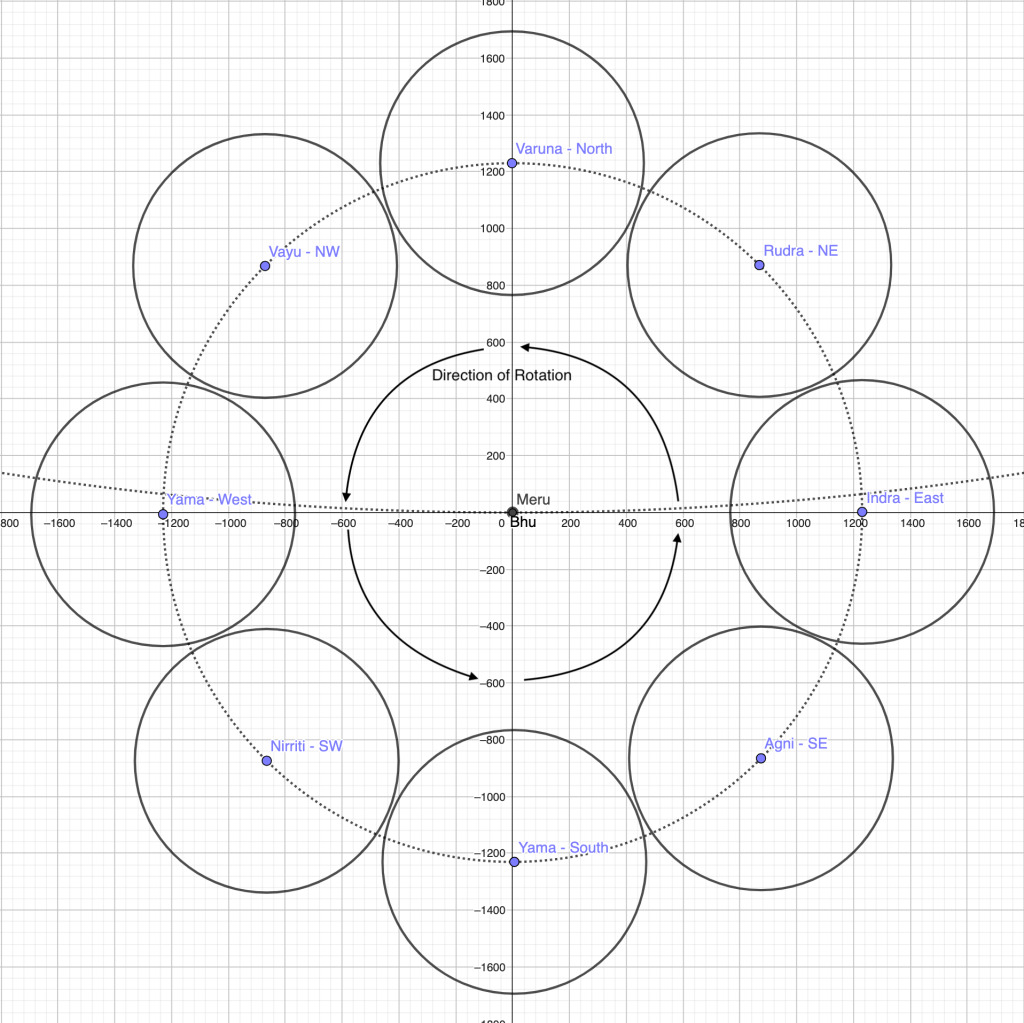
(The viewpoint is down from +z axis.)
The rotation of earth viewed from above (i.e. form Polaris) is counterclockwise. Śuka describes this motion by saying that the cardinal directions intersect the axis to the peak of Meru (the +y axis in this illustration) in the well-known classical order: east, south-east, south, south-west, west, north-west, north, north-east.

(The viewpoint is down from +z axis.)
The revolution of earth around the Sun when viewed from above (i.e. form Polaris) is counterclockwise. Śuka previously described this motion by establishing that the Sun moves from the northern solstice (Mandara) to the western equinox (Kumuda) to the southern solstice (Meru-Mandara) to the eastern equinox (Supārśva) over the course of a year. In reference to the illustration above, this can be seen by halting the rotation of the eight directions, and seeing how they intersect with the pole from Meru to Bhagavata over the course of Bhū’s orbit around Bhagavata in a counterclockwise direction.
This astonishing proof shows that Śuka was aware of both heliocentric and geocentric motions.


 Vic DiCara's Astrology - Radically Classical, Radically Deep
Leave a reply to zuyaa Cancel reply