We tend to think of introversion and extroversion as binary poles on a spectrum, but it would be more useful to think of it as one axis of a multi-axis spectrum.
Reading an article my friend Norman Brannon just published, and his subsequent interview with Sami Kaiser of GEL, I got inspired to think carefully about introversion. Here is a digest of my internal conversations…
We tend to think of introversion and extroversion as binary poles on a spectrum, but it would be more useful to think of it as one axis of a multi-axis spectrum. I think Introversion is an axis in the larger spectrum of Expression, which I think may be at least four dimensional.
- Introversion ⇋ Extroversion
- Closed ⇋ Open
- Quiet ⇋ Loud
- Fluid ⇋ Structured
I think we rely too exclusively on the Introversion ⇋ Extroversion spectrum. I believe each of us expresses our being in a combination of points on all four spectrums.
Introversion ⇋ Extroversion
This axis describes how inward or outward the person’s focus is.
An introverted person focuses within themselves, on their thoughts and feelings. Consequently, they do not have much urge to interact with external people and situations.
An extroverted person focuses outside themselves, on experiences and objectives. Therefore they do have natural instinct to interact with other people and objects.
Closed ⇋ Open
This axis describes how concealing or revealing the person is, when they express themselves.
A closed person does not share their actual inner thoughts and feelings, or couches them very heavily in allusions and metaphors.
An open person does not hide their honest thoughts and emotions, and can be very direct, forthcoming and plain about expressing them.
With this and the previous axis, we can describe closed-extroverts, open-introverts, etc. Perhaps counter-intuitively, many extroverts are Closed. In fact, extroversion inclines an individual towards being closed, because its lack of concern with its own thoughts and feelings leads to a lack of importance placed on expressing them accurately or honestly. Conversely, many introverts are Open. When they do express and share, they do so honestly, deeply, and truthfully. This is because their introversion makes them care about and be in touch with such things.
It is, of course, entirely possible to be an open-extrovert or a closed-introvert.
Quiet ⇋ Loud
This axis describes the preferred medium and style of expression.
A quiet person expresses themselves meekly, softly, quietly. They tend towards understatement.
A loud person expresses themselves boldly, stridently, and loudly. They tend towards dramatic exaggeration.
The quiet person prefers more private conversation, the loud person prefers speaking to a larger group. The quiet person is more effective in non-verbal and written communication. The loud person prefers verbal communication. The quiet person tends to use vocabulary more extensively and carefully. The loud person tends to rely on universally well-known words.
Extroversion inclines this axis towards loudness, and introversion inclines it to quietude – but extroverts can be mostly quiet, and introverts can be mostly loud.
A quiet extrovert: very focused on the external world, but seldom talking and always writing tweets, blogs, essays, and books.
A loud introvert: very focused on the internal world, and when they share anything about it, do so with in loud, bold, blunt, strident words.
Note that either individual is additionally anywhere on the Closed ⇋ Open axis.
Fluid ⇋ Structured
This axis describes how the individual expresses. Their style.
The Fluid focus is non-definitive, non-authoritarian, and democratic. Therefore when expressing, it is more comfortable in peer groups. This medium lends itself best to expression about conventional, everyday experiences and affairs.
The Structured focus is clear, definitive, authoritarian and structured. It is more comfortable expressing itself in venues where authority and hierarchy is established and respected: like in classrooms. It lends best to discussion of “truths” and “realities.”
Verbosity can be thought of as a fifth axis, or it can be subsumed in this fourth axis. This would describe how much non-necessary length the person includes in their expression. The Fluid expression tends towards (or is identical with) verbosity. The structured expression tends towards (or is identical with) brevity.
Example Diagnosis
I would diagnose myself as “IOQS.”
- “I” for introvert
- “O” for open
- “Q” for quiet.
- “S” for structured
The reasons for this diagnosis:
- Introvert because I care little and focus little on events.
- Open because I do not hide my actual thoughts and feelings.
- Quiet because I prefer written over spoken communication.
- Structured because I prefer scientific dialog over so-called “small talk”.
Importantly, we should also score the position on any axis from 1 to 10. I would score myself:
- Introvert 7
- Open 9
- Quiet 3
- Structured 8
The reasons
- Introvert 7 (“very introvert”): not higher, because I do have some extroversive qualities. I like to create objects like furniture or buildings. I care about social affairs to some extent.
- Open 9 (“extremely open”). Maybe I am a little reserved in some situations.
- Quiet 3 (“slightly quiet”): I am mid-spectrum here because I am also comfortable with some forms of verbal communication.
- Structured 8 (“extremely structured”): not 10 (“completely structured”) because I do respect the importance of fluid/ peer-based discussion, and like to participate it in situations where I feel it is appropriate.
Astrological Indicators
Here is an initial hypothesis for how astrological diagnosis could begin.
- Rāhu-Ketu for Extrovert ⇋ Introvert.
- Moon-Saturn for Open ⇋ Closed.
- Venus-Jupiter( or Mars) for Quiet ⇋ Loud
- Mercury-Sun(or Saturn) for Fluid ⇋ Structured
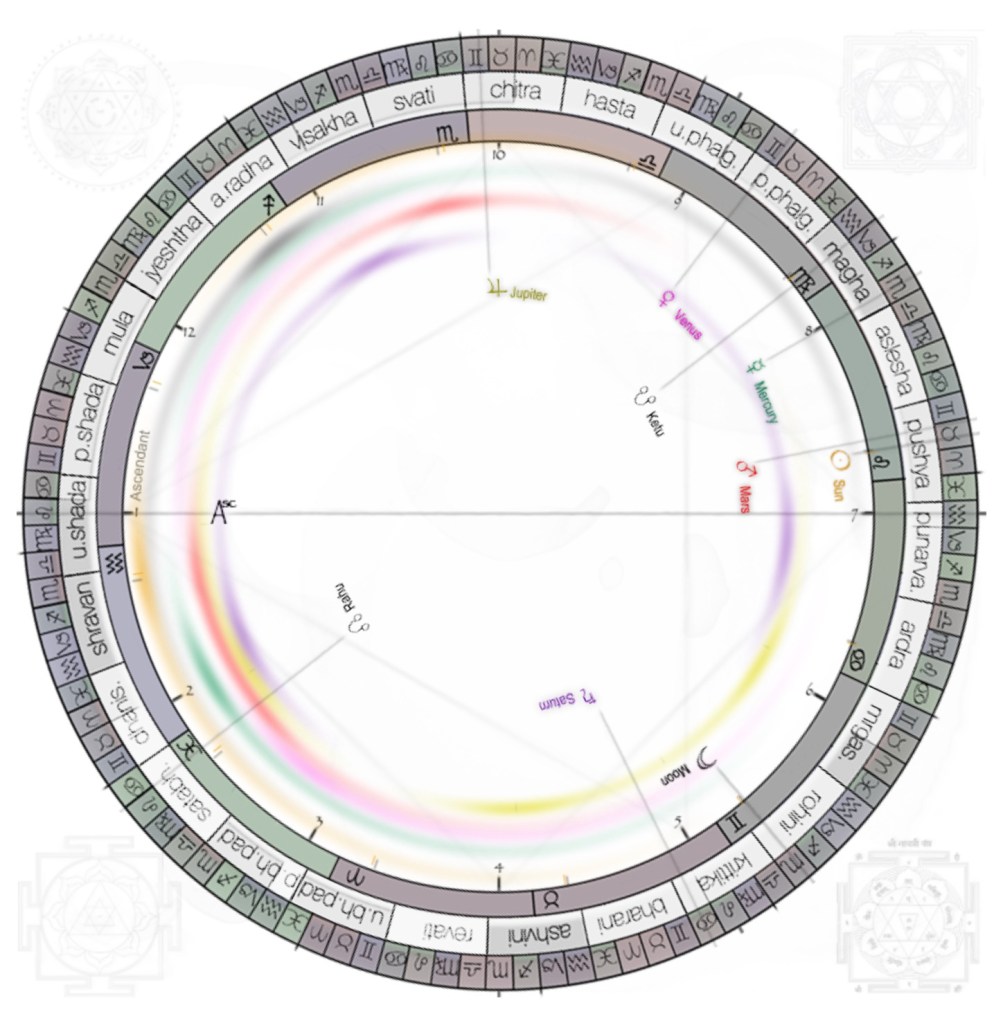
When an indicator goes to a house significant for its axis, it reveals a diagnosis. Its dignity and aspects must be considered. Also the more an indicator has influence in the chart, the more it promotes its side of the axis. Initial ideas of examples using my own birth chart (see image below):
Rāhu-Ketu for Extrovert ⇋ Introvert.
The higher Rāhu is above ground, the more it indicates extroversion.
For example, I have Ketu above ground, about 40% to the apex. It is separated from Mercury by only 1 navāṁśa. It is, by navāṁśa-projection, almost exactly on the ascendant. Accordingly, I am highly Introverted.
Moon-Saturn for Open ⇋ Closed.
The more Saturn is in non-disclosing houses and signs, and the more moon is in disclosing houses and signs, the more it indicates openness.
For example, I have Saturn in Kṛttikā, Taurus in the 5th (i.e. Saturn in disclosing conditions.) I have Moon in Rohini, Gemini, 6th (2 out of 3 disclosing conditions). Accordingly, I am highly Open.
Venus-Jupiter for Quiet ⇋ Loud
The more either is above ground and in conducive houses/signs, the more it indicates its side of this axis.
For example, I have both Venus and Jupiter very high above ground, close to the apex. Jupiter is in 10th, Libra, Citra. Citra supports disclosure, which affects the open ⇋ closed diagnosis and ties it to this quiet ⇋ loud axis. Libra is mid-specturm for this axis. So my jupiter is in mixed conditions. My Venus as well, it is in Virgo, supporting quietude, and with Ketu (tying to introversion) but in Pūrva Phālgunī, supporting Loudness.
Both Jupiter and Venus, by navāṁśa-projection exactly join my Moon.
Mars, the alternative indicator for Loudness, is joined the Sun (enhancing loudness) in Leo (enhancing loudness) but in the 8th house, away from its cusp (de-emphasizing loudness).
Accordingly my diagnosis on this axis is complex and much more mid-spectrum.
Mercury-Sun (or Saturn) for Fluid ⇋ Structured
The more either is in supportive and influential positions, the more it indicates its axis point.
For example, My Sun is in Leo (authority) with Mars (boldness) in the house of scrutiny (8th) in the nakshatra of education (thus hierarchy instruction), Puṣya.
My Mercury is in counter-supportive conditions for fluidity – it is in Magha (structure, hierarchy and authority), in the Leo (authority) in the 8th (scrutiny, not equality).
The alternative indicator, Saturn, is in mixed conditions. But it is the chart lord, indicating more emphasis on the structured side of this axis.
Accordingly my diagnosis is decidedly Structured.


Leave a Reply