Daśa – The World’s Most Thorough and Complete Daśā Evaluation Tool (ORDER HERE)
Page 1
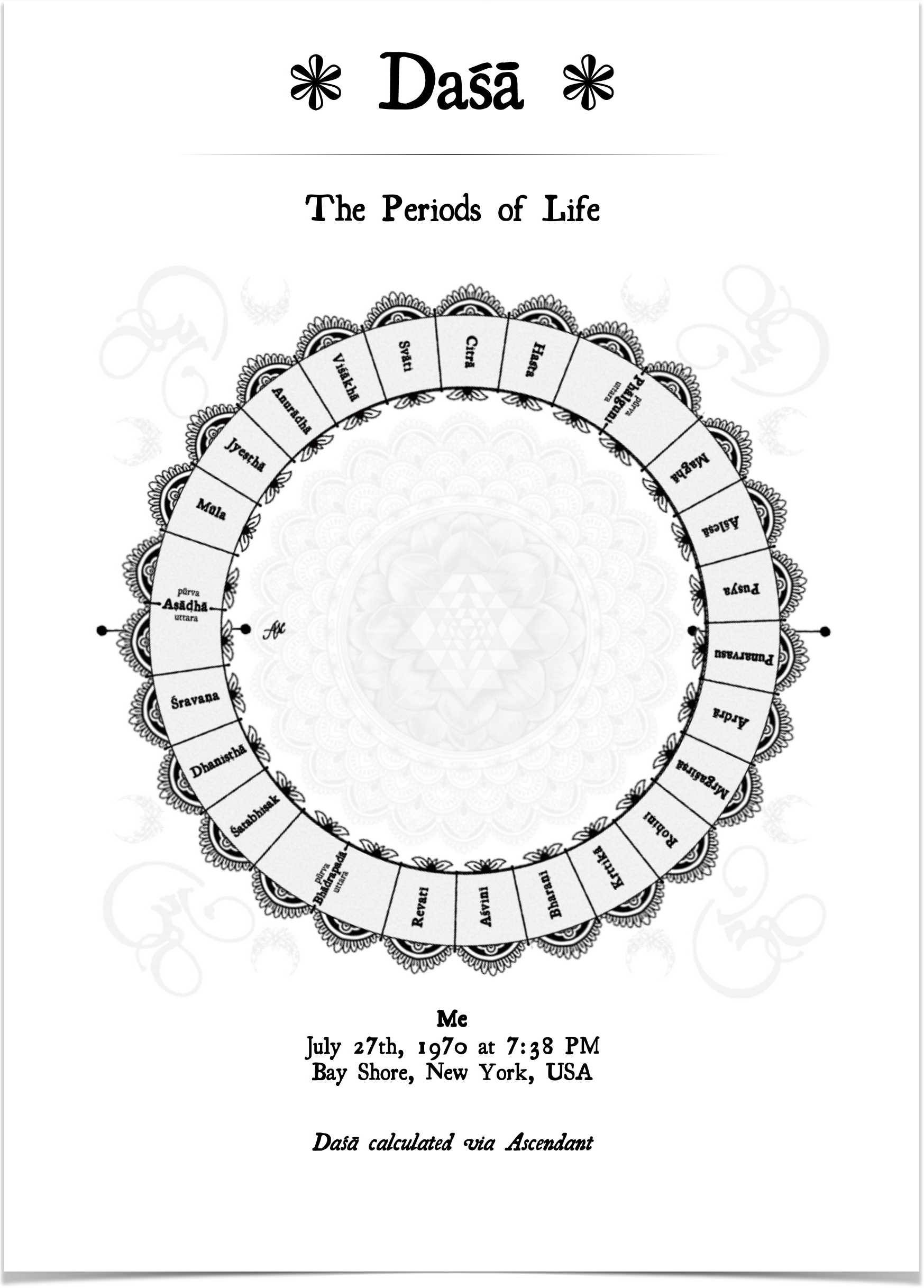
Since this is a report on nakshatra daśā, the front page shows the nakshatra wheel with whichever point you selected to determine the dasha schedules.
And that’s the first amazing point about this report. When ordering it, you can choose whether you want to use your Moon or your Ascendant as the reference point for your daśā schedules.
Daśās are usually resolved in reference to the Moon, but I personally have found they are much clearer when resolved in reference to the Ascendant.
Notes
This report does not make interpretations for you, but gives you the data you need to make them for yourself. This being the case, I would like to give you what I consider the most important interpretive tips.
“Eyes on the Trine.” When you have positivity in multiple trine houses (1, 5, and 9) you could achieve anything. For example, marriage can occur with the 5th and 9th are positive, even if the 7th isn’t.
“Upacaya = gains.” When you have positivity in multiple upacaya houses (3, 6, 10, 11) your ambitions and aspirations easily fructify, and you can achieve material gains like property, income, fame, etc.
Partners matter. For events involving more than one person be sure to check the charts of the other people involved. Marriage, for example, may happen when the wife has a daśā with a strong 7th house. Or, it may be visa versa.
“Right tools for the right job.” Daśā provide a very useful chronological map of the positive and negative fluctuations in various areas of our lives, but other factors are also important, especially for timing very short, specific events like marriages, childbirths, changes of homes, etc. These are usually discovered by finding significant transits that occur in generally favorable daśa.
Mahā-daśā overview Bar Graph
The first half of the report is dedicated to the most universally significant daśā system: the 120-year viṁśottarī system.
We start by looking at the biggest time periods in that system, the mahā-daśā.
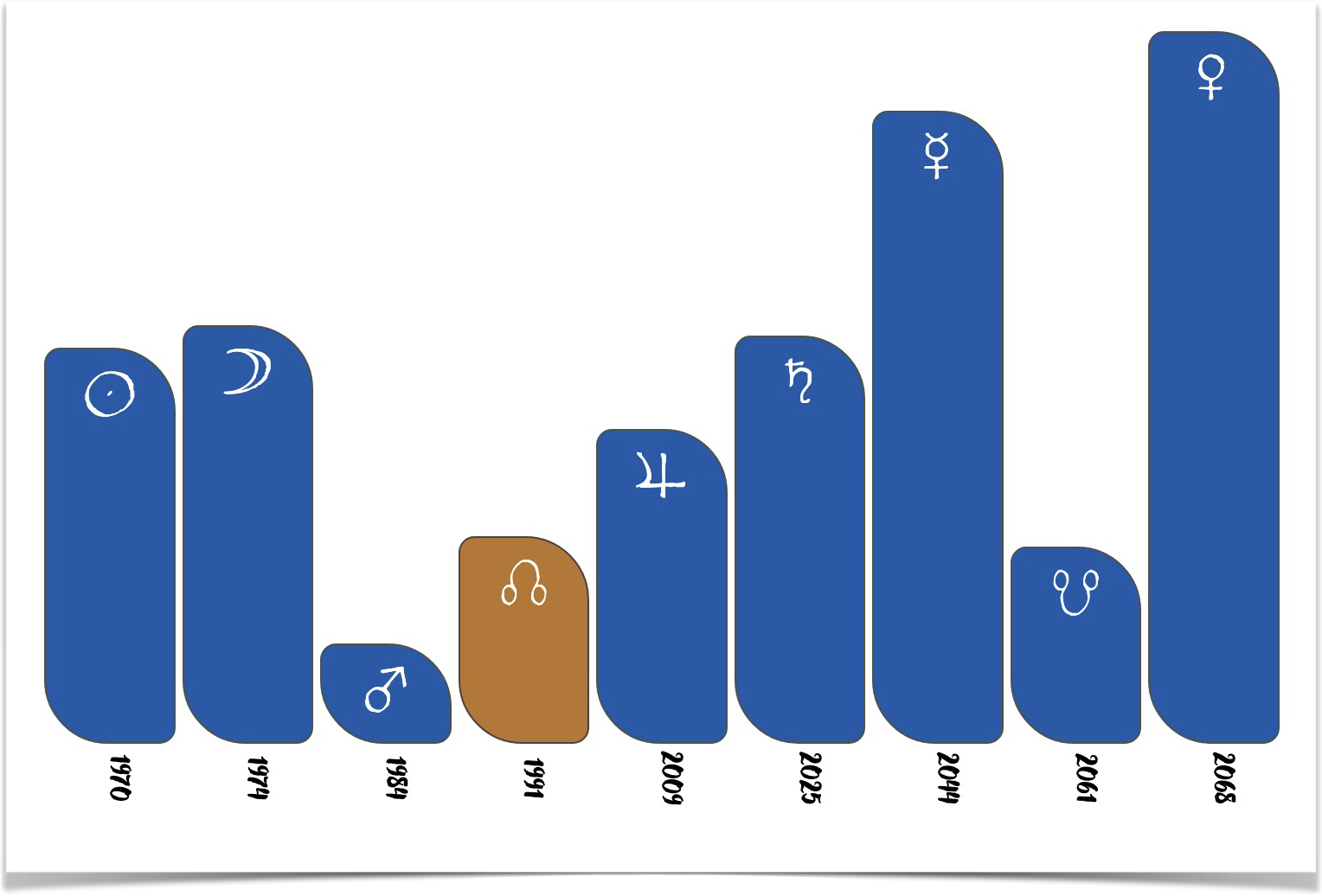
And we start that by looking at a bar graph of the relative difficulty and ease of each period.
Orange bars are negative, or “difficult.” “Difficult” means counterproductive for conventional prosperity. For example, diminished income, comforts, security, etc. We could grow and learn much in difficult periods, and visa versa.

Effect on Houses
After the bar graph we see a table with scores for each house, in each dasha. This is breaking the first bar graph into more detail.
Higher numbers = easier, better effects. Lower or negative numbers = more difficult effects. Negative numbers would be in orange cells. Higher numbers are in darker cells, making them easier to spot and differentiate.
A few ways to use the table…
- Look for the persistent patterns
Find persistent patterns in your strong and weak houses to make big interpretations about the strengths and weaknesses that persist consistently throughout your life.
For example:
Throughout life I am pretty good with houses 5, 9, 12, and 1. And I am pretty weak with houses 3, 11, 7, and 10.
5, 9, and 1 are trines. Having good trines means having good intellect and education, which helps achieve any kind of success and develop any kind of talent. 5, 9, and 12 together suggest a strong proclivity for spiritual practices.
3, 11, and 7 are sensual, kāma houses. 3, 11, and 10 are upajaya. This pattern of weak scores indicates that it is very unlikely to get really rich and enjoy a life of luxury and pleasures.
- Look for standout cells
We can see that 1991 was the beginning of the lowest point for my 10th house.
That same period was the lowest point for my third house, which is about ambitions and desires.
Additionally the period itself belongs to Rahu, which symbolizes sudden, radical change.
So, this presents the interpretation that I had sudden and radical changes in my ambitions and desires, which derailed me from major fame and large-scale success.
Bar Graphs
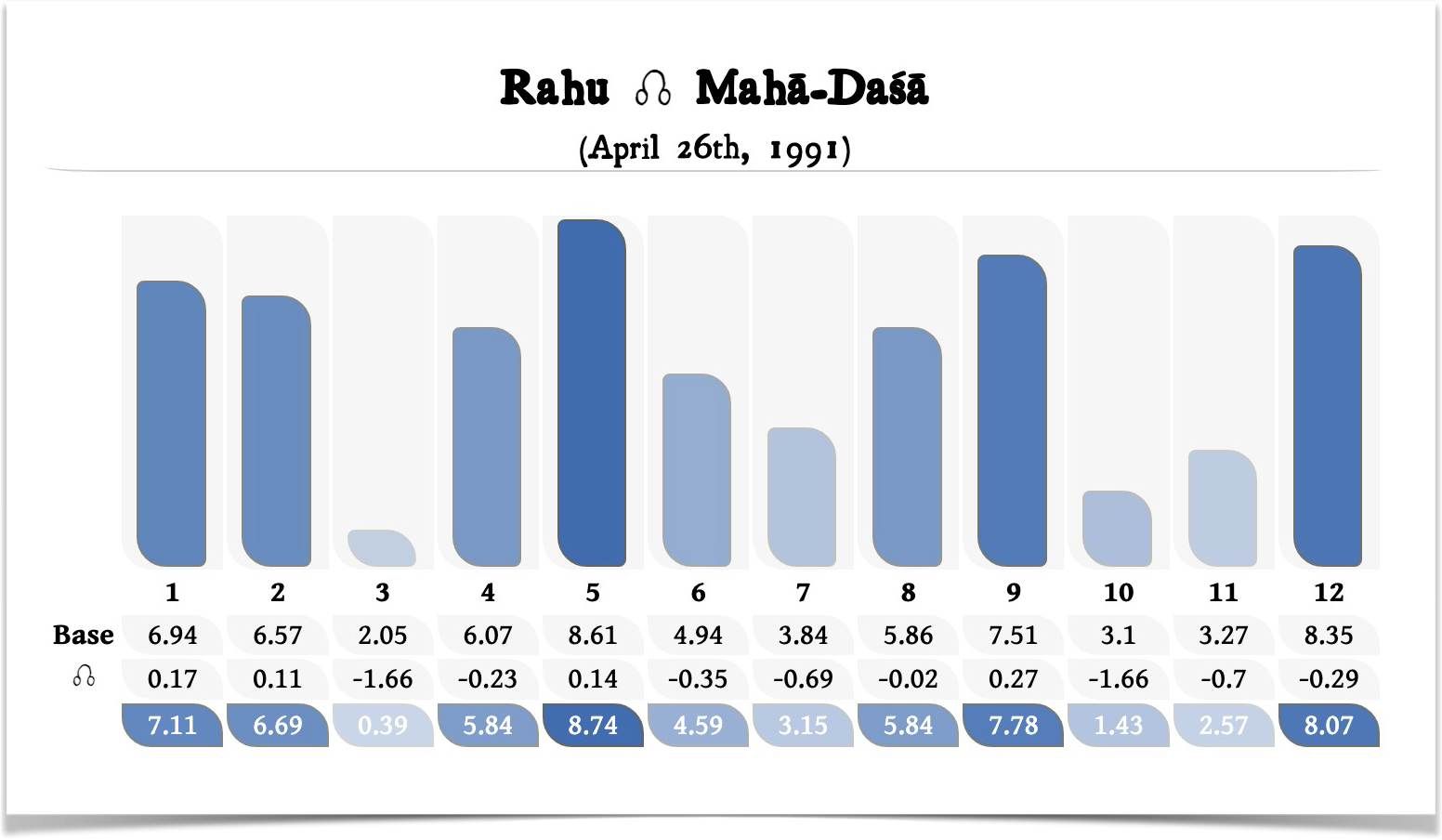
The bar graphs for each mahadasha make it easier to see the high and low scoring houses during that dasha.
EX: Its easy to see that although Rahu dasha was difficult overall, it was prosperous for houses 5, 9 and 12. This is the group that indicates spiritual practice.
Antardaśā
The same presentation of data is presented next, but now it is further expanded to include antardaśā.
[Antardaśā are the sub-periods within the main periods. ]
We have a house-by-house table and bar graph for the antardasha in each dasha. We can use them in the same way we did for the mahādaśā.
Pratyantardaśā
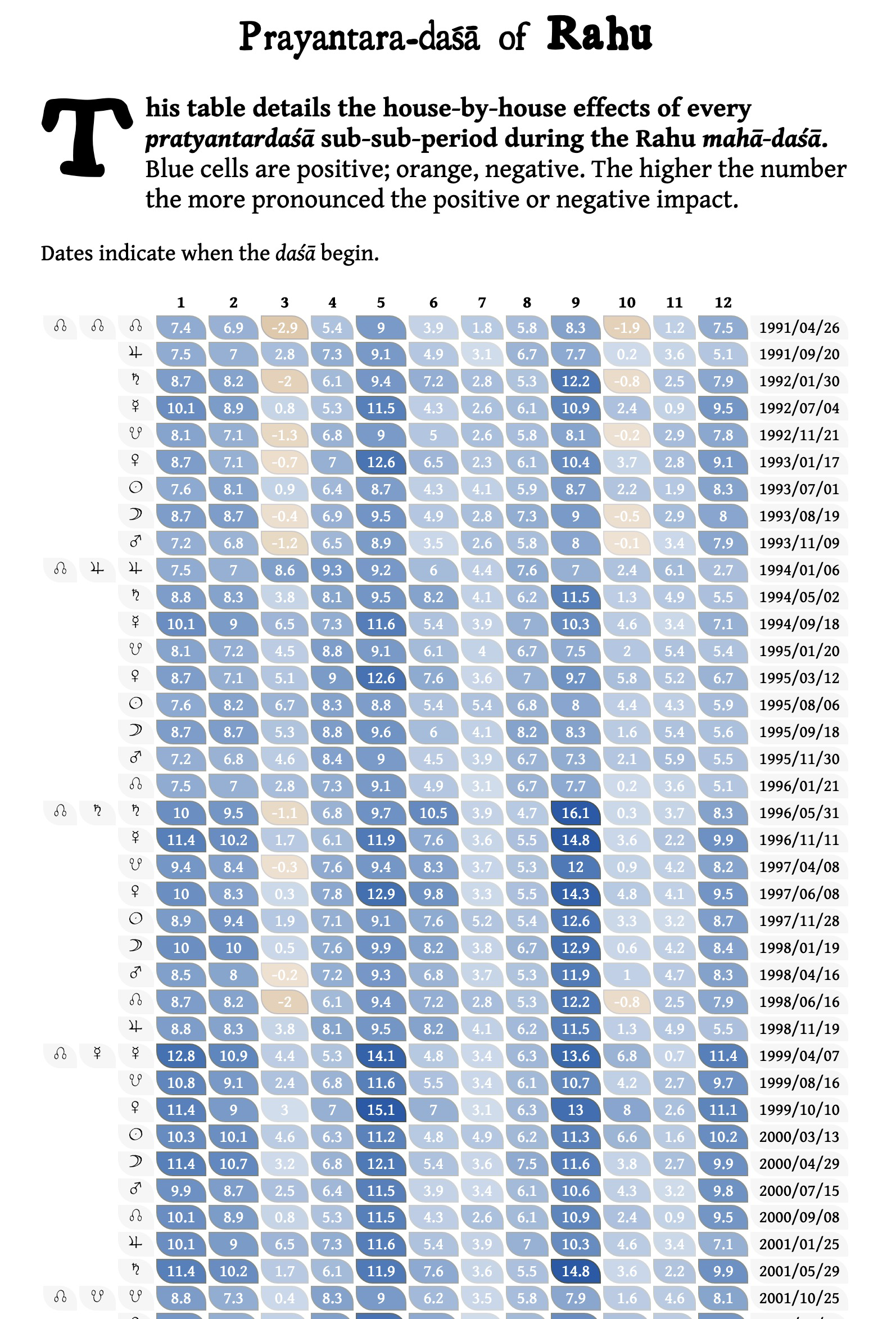
Next is a presentation of the pratyantar dasha. The data is presented as a table giving scores for each house in each pratyantardasha
[pratyantardasha are the micro-periods within the sub-periods]
Scrolling through this lets us see the shorter-scale ups and downs for the various houses. For example, the Rahu/Saturn antardasha isn’t particularly good for my 7th house, but there is ONE micro-period within it, the Rahu/Saturn/Sun period that is a brief positive spike, much higher than the rest of the antardasha.
Indeed I got married during this 7th house spike.
As a heads-up, if we were going to make an accurate prediction of this without hindsight, the most important thing would be that my 9th house was outstanding at the time, as was my 5th, 2nd, and 1st. Without the support of these houses, especially the 9th and 2nd, we would not be wise to predict marriage here.
Also, we would not be wise to use the daśā to predict a short event like marriage, without finding a compelling transit within this period.
Alternative Daśā
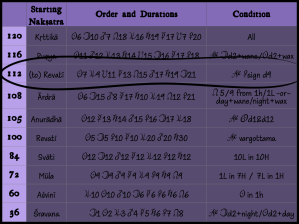
Besides the 120-year Viṁśottarī system, classical texts like BPHS define 9 other nakṣatra-based daśa systems.
Each one starts from a different Nakṣatra, has daśā of different durations in different orders, and has a condition that needs to be met for that daśā system to be relevant to a particular person.
For example, if your ascendant is in a Venus-ruled navamsha signs, the 112 year system is also relevant to you.
After completely disclosing the details of Viṁśottarī, the report moves on to check which of the 9 other systems might apply to your chart.
–
For example, it finds that the 108-year aṣṭottarī system is relevant to me, because I was born during the day while the moon was waning.
The report gives the familiar bar graph and data table for the aṣṭottarī mahādaśā, and also gives the data tables for the aṣṭottarī antar-daśā.
–
Not every daśā system applies to everyone. For example, the 116-year Ṣodaśottarī isn’t relevant to me – because my ascendant is in a solar hora, but while the moon is waning, not waxing. The report still gives the Mahādaśā data even thought this system isn’t relevant to my chart – Just to satisfy natural curiosity.
Composite Charts
This may be the most important section of the report, because it combines all the relevant daśā scores in one place.
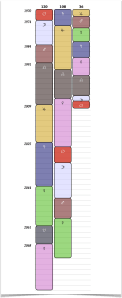
The section starts with a bar graph showing how the mahādaśā of all your applicable daśā systems line up together.
A lot of things jump off the page when the information is visualized like this. For example, it is easy to see I have a span of life in which Rāhu is extremely dominant.
We can also see two benefics operating simultaneously between 2009-2025, evoking a prediction that this is probably a good time, in which beneficial aspects of life were established.
__
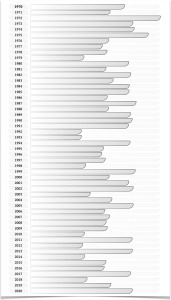
Next we have a composite graph of the positivity of each year of life. This data comes by commingling the mahā and antardaśā of every applicable daśā system for during each year of your life.
This format makes it easy to spot generic ups and downs. For example it looks like 1992 and 1993 were “difficult”.
To a lesser extent (since the duration is shorter) we can spot similar periods in 1998, 2003, etc.
Similarly we easily find high-points in 1972 & 75, suggesting an easy childhood.
___
Next we have a table breaking the same data out to reveal how it pertains to specific houses.
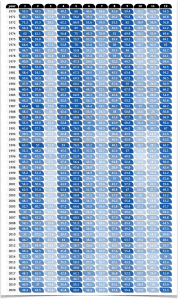
1992 and 1993, for example, were difficult for houses 3, 7, 10, and 11, and not for the other houses. This helps us understand that the difficulty of these years was related to fulfilling ambitions and desires, keeping relationships and partnerships, and achieving fame and profit from ones career.
___
Next, the report gives a technical list detailing which planets were active during which years. This is mainly here for people who really love details and like to know exactly what is going on “under the hood.”
Tech
On that note, the report closes with a technical section showing all the underlying calculations and rules involved in making all these judgements about how positive or negative the houses will be during particular daśā.
First we evaluate each sign using rules from the beginning of Phaladīpikā chapter 15.
Then we convert signs to houses, relative to different lagnas (for the ascendant, the moon, and the karaka of each house).
Finally we evaluate rules from the later half of Phaladīpikā chapter 15 to determine each planet’s effect on each house during its daśā.
The scores used in the report combine the base scores for the houses with the per-planet effects on the houses. Which you can see disclosed in these bar-graphs.
The final page of the report shows the most fundamental calculations the report relies on – the dignity and strength of the planets. These calculations are exactly conformant with Phaladīpikā chapter 3 and 4.
Outro
All in all, I believe this is clearly the most comprehensive and detailed report on nakṣatra daśā ever made available anywhere. You can order it for your own birth chart right now, just go to vic dicara dot com, click into the READINGS section, and select the DASHA reading. (ORDER HERE)
 Vic DiCara's Astrology - Radically Classical, Radically Deep
Leave a comment