The Pythagoras of India was Bharata Muṇi. He sat with a stringed instrument, a Vīna, and tightened a tuning peg slowly and carefully while playing the string. After repeating this many many times, he concluded he could discern 22 distinct pitches (śruti) within an octave.
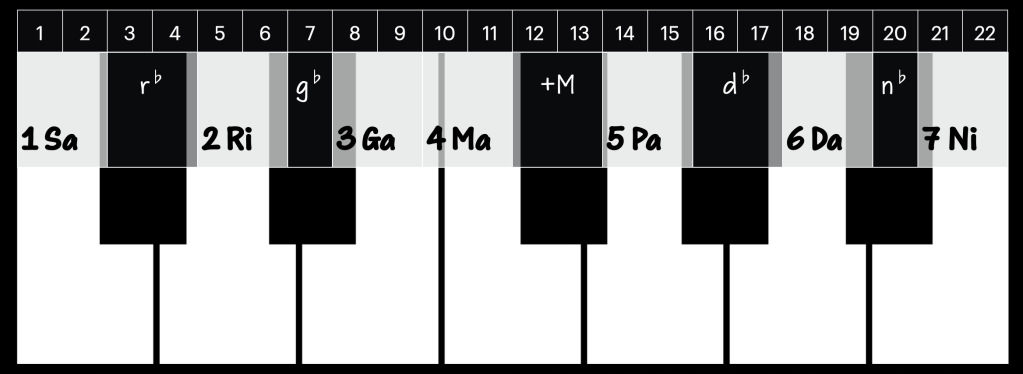
To explain the relationship between these 22 pitches and the 7 primary tones (svara) utilized in music, he said: चतुश्चतुश्चतुश्चैव षड्जमध्यमपञ्चमाः द्वे द्वे निषादगान्धारौ त्रिस्त्री ऋषभधैवतौ – “4, 4, 4 for ṣaḍja, madhyama, pañcamā. 2, 2 for niṣāda & gāndhāra. 3, 3 for ṛṣabha & dhaivata.”

In the large spaces between some of these tones, music also utilizes five secondary tones (vikṛta svara).
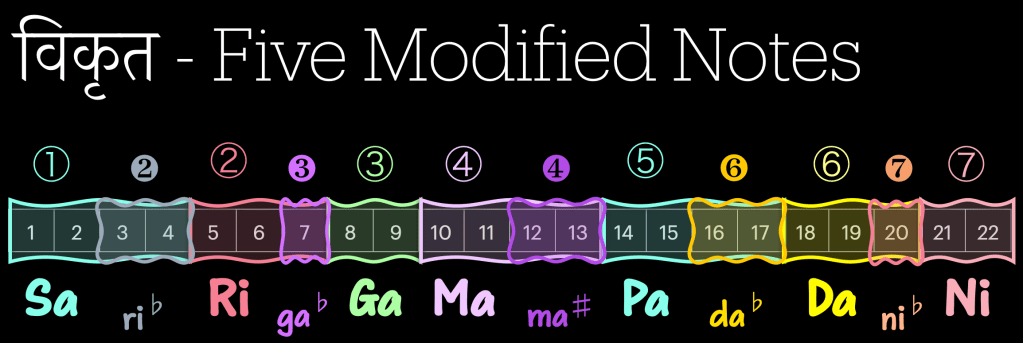
This is the basis of all human music. However, different cultures evolved differently over time – with a clear general difference between cultures in the western hemisphere and those in the east. Western hemisphere, having more rajas, liked to evolve towards more quantity. Hence they began playing multiple notes, multiple melodies, and multiple instruments. This required them to define the musical tones more uniformly and rigidly.
The original Vedic system gives a much clearer insight to how notes correspond to astrological symbols: planets and signs. This is because these notes are defined by their relationship to one another – as are the planets and signs. We will find an exact correlation between tonal relationships and astrological relationships.

Starting with Sa as Sun and Pa as Moon, we ascribe all the harmonious tones to the friends of the Sun, whose signs are at trine and semitrine to the Sun’s leo. And we ascribe all the disharmonious tones to enemies of the Sun, whose signs are square (and opposite) to Leo.
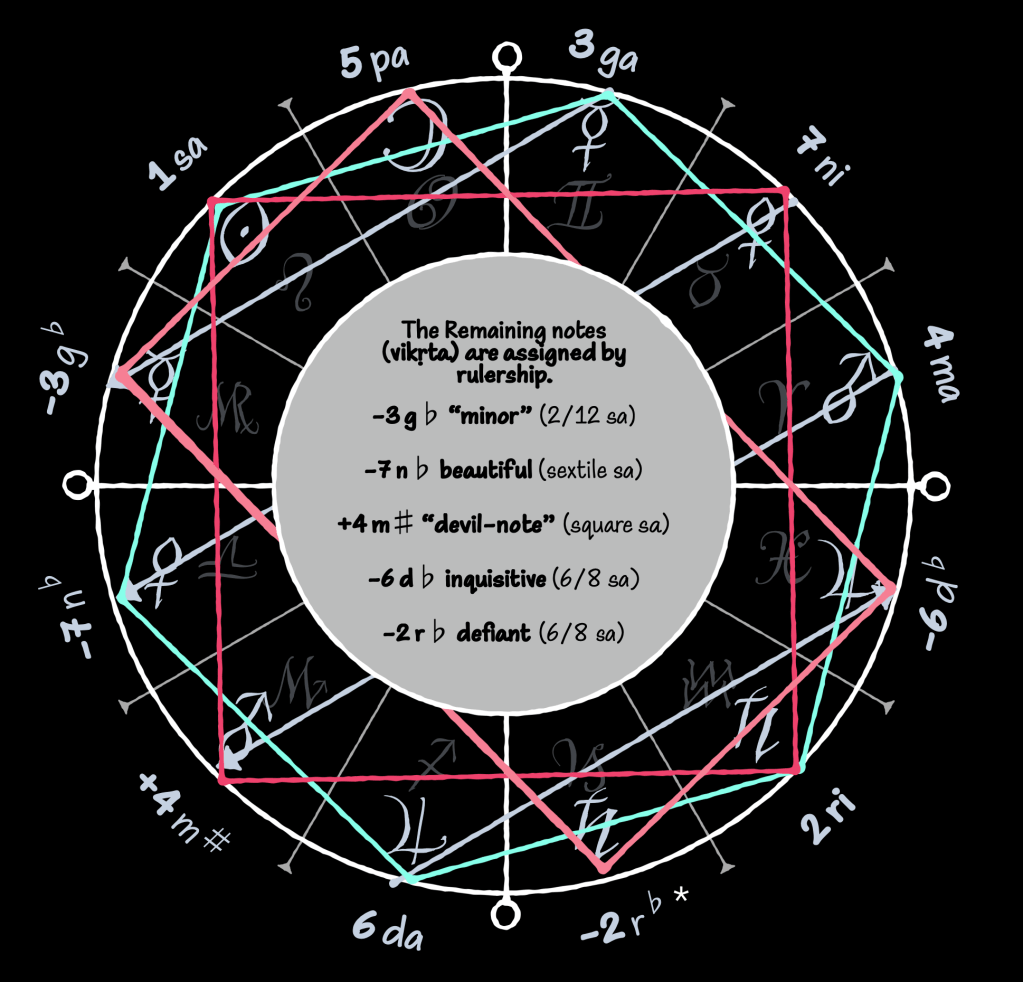
We then ascribe the five modified notes to the five remaining zodiac signs, by rulership; maintaining harmonious notes on trines and semitrines, and disharmonious notes in squares or rectangles to Leo / Sa.
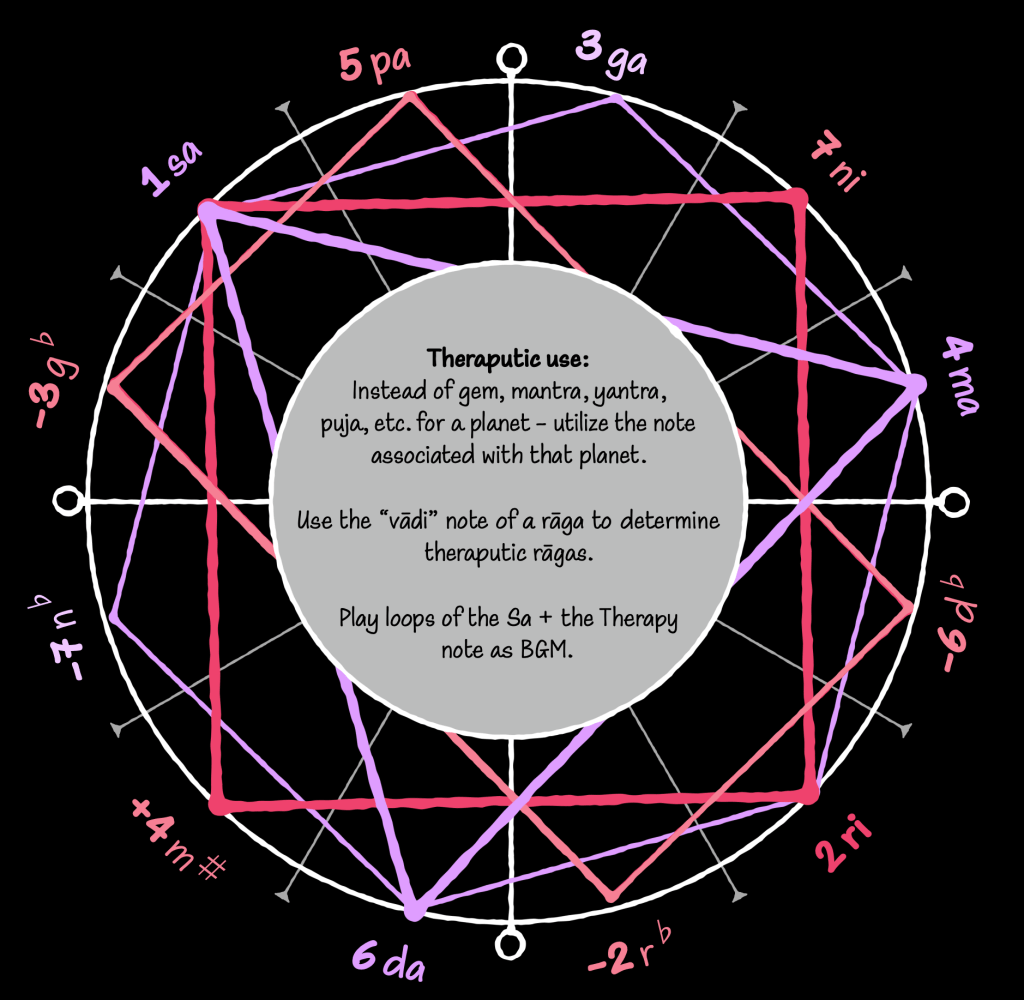
Now that we have correlated planets to tones, we can devise music therapies to aid ailing planets and help people with the things symbolized by those ailments. We can avail of Indian music categorizing their melodic structures (rāga) by primary note (vādi), and we can also listen to, play and sing the intervals of planets requiring aid.
 Vic DiCara's Astrology - Radically Classical, Radically Deep
Leave a comment